
Unit Content Objectives
The Sun
The Sun from a scientific perspective is the first step in this three-part unit. This portion of the unit will be heavily based on our two-week intensive work sessions in the seminar, “The Sun, the Solar System, and Us,” with Dr. Sarbani Basu, Professor of Astronomy at Yale University along with graphics, photos, and information from various NASA websites. In this section of the unit, students will gain knowledge and understanding of the Sun’s beginnings and how the dust around it created the planets in our solar system. How the Sun affects us and our planet is an important thing for students to understand and while I think that most do so on a basic level, we will push that forward for deeper understanding. Students will also need to have a basic understanding of why we are a “Goldilocks Planet” and what keeps it that way. What would have to occur for there to be another planet like ours in a distant galaxy? Or even not so far away? What if this other planet were bigger or smaller, would it need to be closer to or farther away from the Sun? What if the other sun were more or less powerful? These are some of the questions we will discuss as a class based on the knowledge we gain in this section of the unit.
Basic Background
According to NASA, our Sun is approximately 4.6 billion years old. In relation, the Earth is about 4.54 billion years old, approximately a mere 60 million years younger than the Sun. Our Sun is about as “average” as a star can get in most aspects, being average size and middle aged. It is “a run of the mill star”, as stated by our seminar leader. Whereas some other solar systems may have two stars (or more), we only have one, as do most other solar systems. Note: It was previously thought that most solar systems did have more than one star, thus making binary solar systems more common than single star solar systems. As mentioned before, the science, technology, and knowledge of our universe is changing so rapidly, it really is essential to find the most up to date information as possible and vet your resources. As you read this and use the information in your own class, you should probably check into the latest data, just in case, because in a year from now (i.e., July 2021) the discovered and confirmed planets and exoplanets will surely have doubled, tripled, or more! However, our knowledge of the general properties of the Sun has not changed much in the last 20 years, according to Astrophysicist and Professor, Dr. Basu. Barring any major new discoveries, the basic information about the Sun itself should not change.
The Sun is in a constant battle of the outside pressure in due to gravity and the inside pressure out due to heat. However, it is a “reasonably stable thermostat” according to our seminar leader. This is a good thing considering that nuclear fusion is constant in the Sun’s core where hydrogen is converted to helium. This happens when the high temperatures at the core of the Sun cause the positively charged hydrogen nuclei to move faster, and they are able to fuse and form helium. This fusion reaction releases energy, the energy then makes its way to the outer surface of the Sun. Figure 1 shows the surface of the Sun to the upper atmosphere in different wavelengths of light. The wavelengths show off features related to the heat radiating from each layer. The surface of the Sun on the left is about 6,000 degrees Celsius or 10,832 degrees Fahrenheit. The outer atmosphere, much like the core, are much hotter than the surface. The outer atmosphere is about 10 million degrees Celsius or 18 million degrees Fahrenheit! The core (not shown in this image) comes in at about 27 million degrees Fahrenheit.
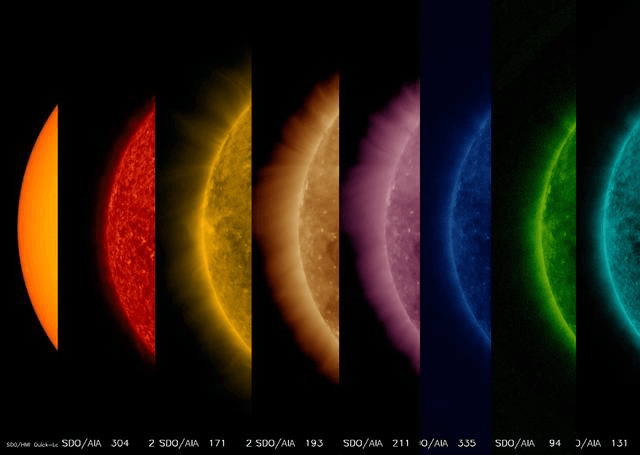
Figure 1. From Hot to Hottest. The Sun from its surface to its upper atmosphere. https://images.nasa.gov/details-PIA22055
It is hard to say with exact precision how far we are from the Sun, unless you specify a specific moment in time. This is because the Earth and the other seven planets (yes, only seven others- Pluto has been declared a dwarf planet since 2006) revolve around the Sun in orbits that are ellipses, not perfect circles. Additionally, the Sun is also rotating and wobbling and revolving in its own ellipse as it is moving in its orbit around the spiral of the Milky Way galaxy, which in turn is a galaxy cluster (in which multiple galaxies rotate around the center of mass). With all this, astronomers have measured the distance and the Sun is, on average, 93 million miles away. Currently, literally today, July 20, 2021, we are 150 million km (93,205,678) miles away from the sun. Comparatively, on January 2, 2021, we were a mere 91,403,702 miles away.3
Helpful (and Weird) Comparisons to Earth.
The Sun is 700 Mega meters wide and weighs 2 billion billion billion tons (1.989 x 1030kg). Thus the diameter of the Sun is 109 times the diameter of the Earth and it is 333,400 times the mass of Earth. If the Sun were a gumball machine that was filled completely with Earth sized gumballs, you would get 1.3 million Earth gumballs packed into that machine. Figure 2 shows the size differences of our solar systems planets to the Sun.
If you were to scoop a tablespoon out of the core of the sun it would be about 2 kgs, or 5 pounds. Alternatively, a tablespoon of the Sun at its surface would be practically undetectable since it doesn’t have the pressure and compression that the core experiences. Obviously, it is not possible to get a scoop of solar material, but it shows that the core is very dense. Our planet’s core is not nearly as dense and heavy as the Sun’s core however, a tablespoon of the Earth’s crust would actually be heavier than the tablespoon of the exterior of the Sun.

Figure 2 The planets in our solar system compared to the Sun. https://www.jpl.nasa.gov/infographics/ratio-of-planets-to-the-sun
Birth of the Sun and Planets
Clouds of gas collapse and heat up. That could be an extremely simple explanation of what happens when a star forms, but it is definitely more than that. I will not be delving too deep into this information, but will give a little more than that. In “The Lives of Stars” the authors document the importance of sound-like density waves that compress matter in a galaxy’s spiral arms.4 The gas and dust in these arms collect into a cloud called a nebula. More than 4.5 billion years ago one of these nebulas collapsed under its own gravity with most of the material being pulled to the middle as it spun itself into a flat disk with our Sun as its centerpiece and the surrounding debris set to eventually collect, collide, and form planets. The planets closer to the Sun became heavy and rock laden while the outer planets became heavy with gases due to solar winds pushing the gasses away and heavy materials being attracted to the Sun’s gravity.
In “The Nearest Star” it is pointed out that our Sun was definitely not one of the first stars in the Universe. The Universe is about 14 billion years old and our Sun is only 5 billion years old. Because of this, “it, and the planets around it, contain heavier elements formed when earlier stars became novae and supernovae”.5 Oxygen, silicon, iron, carbon, and other elements are what make organic life possible. Therefore, the oldest of stars are not likely to have planets with life because they do not have the elements needed for life. Hydrogen is the number one most abundant element in the Universe, the second being helium. Therefore, it is no surprise that stars, which make up the mass of the mass in the Universe, would be mostly comprised of hydrogen and helium.
How the Sun Affects the Earth
Our atmosphere and our ozone layer are absolutely essential to life on Earth. Without our atmosphere we would be living (or rather not alive at all) on an ice-covered planet. It would be way too cold for life to form, as metabolism would be impossible. The Ozone layer, made up of 03 molecules, protects us from the Sun’s harmful short-wavelength ultraviolet radiation. Without ozone, “all animal life (not just humans) would be more susceptible to cancer, impaired, immune systems, and eye problems like cataracts.”6 Additionally, without the Ozone layer, life would not have been able to form in the way it did to begin with because of all the radiation from the Sun during the initial growth and evolution of organic molecules. The radiation would likely have altered or destroyed the initial growth of new life.
We have started to see what the warming of the planet is doing to our Arctic regions. As more and more permafrost melts at and near the poles, we know more and more carbon is being released from the ice, sometimes as methane, which is even worse for the atmosphere than carbon. That release of carbon and methane from the poles as the Earth warms, as well as chlorine and bromine from industry and other human activities, causes the ozone to deplete more, warming the planet more and letting in short-wavelength ultraviolet radiation. In the end, the disappearance of the ozone layer will destroy our atmosphere. With the destruction of the atmosphere, our planet will start to cool. It’s a vicious cycle ending in a planet entirely too cold to survive on. Humans did respond to this issue in 1989 by banning ozone-killing gasses and have been working on cutting down emissions ever since. The ozone has been replacing itself slowly, but humans are still emitting too much CO2 and methane and the use of banned ozone-destroying gases is actually on the rise. It is debatable as to whether humans have proven to be very successful caretakers of our planet, unfortunately.
The Sun can also affect the Earth with solar flares that are sometimes paired with coronal mass ejections (CMEs). A CME is a physical discharge of plasma and magnetic field from the Sun’s corona, while a flare is the release of electromagnetic energy from regions on the Sun where we see sunspots. The flare or the CME themselves are not powerful enough to affect the planet or the living things here on Earth, but their effects can harm technology. The number of sunspots on the Sun increase and decrease cyclically with a period of about 11 years. When the number of sunspots is the highest the Sun’s magnetic flips, meaning the north and south poles trade places. Since CMEs occur where the sunspots are, they occur quite regularly depending on where we are in the 11-year solar cycle, but they are rarely so energetic that they affect human society, too much. We discussed in seminar an event in 1859 that produced a solar flare large enough to knock out telegraphs and cause auroras to be visible in much of the world. In May 1967 a CME jammed radars during the Cold War and the United States thought it was Soviet caused. Luckily, military space weather forecasters quickly figured out the issue and the aircraft that were prepared to launch were held back. A major war was almost triggered by the Sun! In today’s world, a CME the size of the Carrington Event of 1859 could possibly knock out communications all over the world. The next expected solar maximum is in mid-2025, but we do have satellites now that warn us of large CMEs giving the satellite and the people on Earth the time to shut down the grid for long enough to miss the most harmful effects of the CMEs. The radiation from the solar ejections could also hurt astronauts doing space walks, so they have to be cautious of when the Sun is active and refrain from leaving their stations. We are fortunate that our atmosphere protects us from the major part of such dangers.
The link between solar activity and climate is not a solidly understood topic, as of yet. The Sun does drive weather systems and the Sun does have the 11-year cycle that scientist know fairly well. However, it is not to blame for rising greenhouse gases and the loss of ozone. The cycles, the sun spots, the flares, none of these can explain rare events like the winters in the 1660’s, 1770, and 1850 in Europe. As if the Great Plague, the Revolutionary War, and the Crimean War were not enough during those years, winter had hit especially hard each time and these centuries combined were part of what came to be called the Little Ice Age. None of which had anything to do with the Sun or its cycle, as per our knowledge.
Goldilocks Planets
Not too hot, not too cold, Earth is considered a Goldilocks Planet because it was just right for life to form and evolve. In “Nearest Star”, it is stated that “…life as we know it appears to be possible within only a narrow range of conditions…” and reflects on the need to understand our planet in order to take care of our planet.7 In the first 60-100 million years on our planet there were only inorganic molecules. Whether it was primordial muck, a cataclysmic event, hot springs, tidal pools, or something entirely different, those first inorganic molecules changed. They became organic and they were the origin of life on our planet. Over nearly four billion years the original organisms evolved into everything living on Earth today.
We know that the Sun is key to life existing on this planet. Life on this planet is able to exist in a variety of climates and biospheres due to evolution and adaptations. However, “we are not in a good position to argue that this range of temperatures is absolutely essential for life, but it is generally necessary for the types of life that we see here”.8 As with much of what we “know” about the Universe, the theories of life’s origins change as we gain knowledge. Just as new species are found or new viruses attack us here on Earth, new planets are discovered, stars are born and stars die in our Galaxy and beyond. Our understanding of the Universe is growing, but certainly not exhausted. The likelihood of other Goldilocks planets could be quite plausible. In seminar we discussed the three general schools of thought that could explain the possibility of life.
Schools of Thought on the Origin of Life
- God
- The incredibly implausible
- The unavoidable
The first school of thought is that God created the heavens and the Earth with the snap of a finger and everything just was. Most know the story in some form or another, regardless of what religion is or is not practiced. In general, this school of thought entails that there is but one planet with life, Earth, and everything on it was created by God. The second is school of thought says that life on any planet is incredibly implausible, meaning that it was a fluke for life to form on Earth. If another Goldilocks planet does exist, it is highly unlikely that it would have life at all and it was just by chance that life started on our planet. The third school of thought is that life is simply unavoidable because autocatalytic metabolisms are natural properties of complex systems. Thus, given another “Goldilocks”, life would be somewhat inevitable. Life is made of chemical reactions that allow metabolism, reproduction, and evolution. It is inevitable that organic substances would exist on other planets and create some form on life adapted to a planet’s atmosphere.
With consideration of the third school of thought we can look to other planets in hopes of eventually finding life elsewhere. Figure 3 shows two Kepler stellar systems that could reasonably show or produce signs of life. According to the “Unavoidable” school of thought they should in fact be capable of hosting life based on the strength of their respective stars and their distance from them. The Kepler-452 system has a star that is somewhat brighter than our own and a planet revolves around the star in a slightly larger elliptical orbit than our own orbit around our Sun. Kepler-186 has a star that is fainter and smaller than our own, but the planet has an orbit around the star that is closer in size to Mercury’s orbit (which is far too close to our Sun to have life). If most of the stars in all the Universe have one or more planets it seems inevitable for some of them to be in a habitable zone for life to evolve.

Figure 3. Kepler systems with planets in the habitable zones. https://www.nasa.gov/ames/kepler/kepler-452-and-the-solar-system
In seminar, Dr. Basu pointed out that we are hampered by the biases of life on Earth when considering life on other planets. We expect life on other planets to follow our own rules. Here, life is determined by ordered structure, reproduction, growth and development, energy utilization, response to the environment, homeostasis, and evolutionary adaptations. However, we do have things on Earth that do follow the biases, but aren’t truly alive. Consider fire, crystals, hurricanes, and computer AI, these things do in fact have all the characteristics that determine “life”, but still are not alive as they do not have genetic information. With this in mind, we know that carbon is the basis for life on Earth and that life cannot exist on Earth without water and a source of energy. For us, as humans, to live on another planet we would need sources for water, oxygen, food, and shelter. It is interesting to ponder life on another planet and if intelligent life does exist, what does it look like? Do they look just like us or have they adapted to their planet differently than we have?
The Sun Stories
When students are in elementary school they hear stories about the Sun, often through Native American or African studies of culture. Stories about how the Sun got in the sky or how night and day came to be are not uncommon. Later, students may learn about Greek gods and goddesses that ruled over man, each having a realm to rule such as the ocean, the land, or the sky. In these stories the Sun varies greatly between something to be respected, worshipped, or feared. Sun worship and sun stories can be traced back through many ancient civilizations, though, according to Encyclopedia Britannica the Egyptian, Indo-European, and Mesoamericans were the only cultures that developed actual solar religions based on a single solar deity.9 Many other polytheistic cultures have one, if not many, sun gods and goddesses (along with other non-Sun gods and goddesses).
In our unit we will look at several Sun stories and Sun based religions from around the world so that students can understand that people all over the world, since before written history have worshipped or at least respected the Sun, and how varied these stories can be. One of our class activities will be for students to discover Sun worship and Sun stories. Information and images will be explored first, and then students will be given access to various books and suggested websites to help them explore on their own.
- Huitzilopochtli is from the Aztec religion, patron of the Mexica tribe, deity of war, sun, and human sacrifice. His name means “Hummingbird of the Left”. The Aztecs believed that warriors killed in battle returned as hummingbirds. Huitzilopochtli was a very important god to the Aztecs and many humans were sacrificed in his honor. According to ancient legend, Huitzilopochtli led the Aztec people from their homeland and told them that there would appear an eagle with a snake in its mouth and that is where they were to build their capital.10 The eagle with the snake in its mouth is now on the Mexican flag. Huitzilopochtli’s image is still quite commonly seen in Mexico.
- Ra, god of the sky, the Earth, and the underworld, was believed by ancient Egyptians to be the creator of all things and is often recognized by his human body and falcon head with the Sun disc resting on top. The Egyptians believed that all other gods had aspects of Ra and even “pharaohs often connected themselves with Ra in their efforts to be seen as the earthly embodiment of the Sun God”.11
- Helios was the god of and personification of the Sun in Greek mythology. The Greek god Apollo is considered a god of the Sun, but was actually the god of light along with music, art, archery, plague, poetry, medicine, oracles, and knowledge. Sol was the Roman equivalent of Helios. Like Sol, Helios was known to ride across the sky in a horse drawn chariot.12
- Bila, of the Australian aboriginal Adnyamathanha people, is the personification of the Sun. She was a cannibal and roasted her victims over a fire (the origin of sunlight) and was thrown into the sky by the “Lizard Man”. She left the world in darkness, so a boomerang was used to catch her, causing her to move in an arc across the sky to light the world again.13
- Surya, of the Hindu religion, is another god that rides through the sky on a chariot pulled by horses. Seven horses to be exact, seven represents the seven visible colors and seven days of the week. Surya, or Aditya, is considered the creator of the universe and the source of all life. He is an important figure in Hinduism and a minor deity in Buddhism.14
- In the Cherokee tribe, they tell of the Sun and her daughter in that the people tried to kill her daughter, but killed her instead. In her grief they find their need for her and work to make her happy. The Cherokee also have the tale of the Moon that is in love with the Sun and chases her day and night, promising her a home they can live in together. It is a tale reminding Cherokee people that they too are without a home, but that they have home for the future.15
- Eastern Nigerian Folktale- Cartoon like video version of the original book telling why the Sun and Moon are in the sky.16 In the story, the Sun and water are friends who both live on Earth. The Sun visits his friend the water and invites him to his own home. The water eventually does go to the Sun’s home, but floods it and the Sun and Moon flee to the sky.17
- Amongst the Dine’ people of the Navajo Nation the stories of the past are being lost along with their language due to English in schools and at home with parents who were often forced to speak English. Some may know about the Navajo Code Talkers who used their language during World War II because it was such a complex and rare due to the language being all but lost when the US was trying to destroy all Native culture. However, the people still revere and respect the Sun in many ways. When speaking with Elizabeth Isaac, a member of the Dine’ tribe, it was told that the Sun is treated like a human among her people.18 It is tradition to build houses with the front door facing the rising sun in the east and during eclipses the people are meant to do nothing as a sign of respect: sit, doing nothing, no eating or drinking, no TV or radio, no reading or singing. The younger generations do not follow this, but they are aware of the elders and their respect for the Sun. She did not recall any Sun stories from childhood. However, there are several stories to be found online for the Navajo people regarding the Sun.
Students may also be able to share personal cultural knowledge they have about Sun gods . It is very possible that some students will look into it on their own out of curiosity, if they don’t already know. (Personally, I delved into Irish Sun gods and found it fascinating.)
The Art
The third and final aspect of this unit is the portion dealing with art. While looking at Sun stories we will also delve into the art that represents the stories, myths, and religions. It is important for students to see the variety of the art is as broad as the stories themselves. Students will see pieces shown by the teacher for example, but they will also find art that goes along with the Sun stories they discover from a chosen culture. Before starting on individual work, the class will brainstorm together to create a new planet based on one of the Kepler planets mentioned previously. Students should understand that this is part of the art project, the planning stage. Students will take into consideration whether their star is smaller and closer or farther and larger than our own Sun to determine the size of the planet and how bright the star is to the inhabitants there. They should understand intelligent life exists on the planet and may even include animals, bugs, plants, etc. What do the people there look like? We are going to go with the general human form, but students may want to add adaptations for their planet. Where do the people live? What are cultural aspects for the people such as clothing, religion, food, holidays, etc.? Then, students will each create a sun story for their chosen imagined culture. Finally, students will take on the task to create a piece of art that represents their story as a whole. The art will inevitably take longer than the lesson if it is well planned out, as well as mindfully and intentionally completed.
Comments: