
Background Knowledge and Content Objectives:
Middle school students will investigate the tradition of Alebrijes and their connection to Mexican identity, as well as examine biodiversity, ecosystems, and the impact of human activity on animals and their habitat. Each student will research two to three animals—choosing one each from the classifications of mammals, reptiles, and birds—and conduct scientific and observational studies, including a field trip to a local zoo. They will record video, take notes, and sketch their chosen animals from life, focusing on anatomical structure, movement, and environmental context.
While reading the book written by Elisabeth R. Fairman , editor Of Green Leaf, Bird, and Flowers: Artists’ Books and Natural World, I came across this quote and her beautiful yet thought provoking art by Tracy Bash, “Nine Wild Plants,” 2006. “Living in a consumer society, people are encouraged to become ‘brand aware.’ Children as young as two can confidently recognize brand names and logos, sometimes before they can recognize their own names. It has been estimated that the average Western adult can recognize a thousand brand names and logos but less than ten wild plants.” page 84. This quote made me think how often students don’t know the difference between a mountain lion that lives in the North American Continent and the ones from Africa. More importantly this makes me think how much more our students have never been to a zoo. This might be the only time or the first and last time they get to go to the zoo. I know this will surprise the average educated person: but so often I find that my students have never left their neighborhood of Brighton Park. By teaching them about zoology and art I hope to expand their horizons, geographical and conceptual.
This unit will have a field trip, art history component, and drawing from life animals and making careful observations of their animals on a sketchbook or handouts that require the students to capture the animal’s movement, features, fur, scales, and feathers. It will culminate with taking their two-dimensional art work, based on close observations, to the final stage of three- dimensional Alebrijes. Students will present all their work and might even move on to create miniature dioramas emulating the ones at the Peabody Museum in New Haven.
From their research, students will reflect on which elements of their animals they wish to combine to invent a symbolic, mythical Alebrije. Their final creation will merge imagination, biology, and narrative—becoming a deeply personal artistic representation of identity, culture, and ecological awareness.
Students will engage in critical analysis of selected works by seven artists whose representations of animals span historical, cultural, and scientific contexts. These include Sir Edwin Henry Landseer’s Portrait of Mr. Van Amburgh, As He Appeared with His Animals at the London Theatres (1846–47); Jacques-Laurent Agasse’s zoological studies such as Zebra (1803), Tiger in a Cave (1814), Group of Whelps Bred between a Lion and a Tiger (1825), Guanaco (1848), and Clouded Leopards (1825); and selected bird illustrations by John James Audubon from volumes I and IV of The Birds of America. The curriculum also includes the anatomical studies and equine portraits of Georges Stubbs, most notably Whistlejacket (c. 1762) and A Comparative Anatomical Exposition of the Structure of the Human Body with that of a Tiger and a Common Fowl (1804). Stubbs’ meticulous representations of horses reflect both scientific precision and aesthetic mastery. His work is distinguished by a rigorous study of animal anatomy—achieved through dissection and direct observation—which informed his lifelike depictions of musculature and movement. Stubbs stands as a pivotal figure in bridging art and early veterinary science, and his paintings serve as models for understanding both the form and function of animal bodies.
The unit is structured in two interrelated phases: first, an in-depth exploration of historical and contemporary artists whose work centers on animal representation; and second, the creation of original Alebrijes by students, synthesizing both scientific observation and cultural storytelling.
The historical component culminates in a focused study of two pivotal artists: Pedro Linares, the originator of the Alebrije tradition in Mexico, and Lori Hogin, a contemporary American painter whose surreal creatures critique modern sociopolitical issues. Linares’s fantastical papier-mâché sculptures—conceived during a period of personal illness and economic hardship—serve as profound acts of cultural resilience and imagination. His Alebrijes are deeply rooted in Mexican folk-art traditions and spiritual symbolism, reflecting a legacy of artistic innovation born from adversity. In contrast, Hogin’s hyper-saturated, genetically implausible animals—produced in the late 20th and early 21st centuries—serve as satirical commentaries on consumerism, biotechnology, and environmental collapse. Together, these two artists frame a rich dialogue between cultural heritage and contemporary critique, enabling students to examine the evolving relationship between humans, animals, and their environments across time and context.
Building on this critical foundation, the second phase of the unit invites students to design and construct their own Alebrijes. Drawing inspiration from zoological research, anatomical studies, and the artistic approaches of Linares and Hogin, students will conceptualize hybrid creatures that reflect both scientific knowledge and personal or cultural identity. This hands-on component encourages creative expression, critical thinking, and cross-disciplinary application, bridging the visual arts with biological sciences.
Students will develop expertise in visual literacy by learning to interpret works of art as primary sources, applying analytical and evaluative skills to understand meaning, context, and intention. This process is grounded in the Illinois Arts Learning Standards for Visual Arts, particularly Responding Anchor Standards 7, 8, and 9, which support students in observing, interpreting, and making informed judgments about artistic work. Under Standard VA:Re7.1, students learn to perceive and analyze visual imagery, developing descriptive language and critical observation skills. Through Standard VA:Re8.1, they deepen their interpretive abilities by exploring how meaning is constructed and how viewers engage in the process of art criticism. Finally, Standard VA:Re9.1 guides students in applying criteria to evaluate artworks, encouraging thoughtful judgment based on formal qualities, cultural significance, and personal response.
By engaging with these standards, students move beyond passive viewing to active inquiry, treating artworks as complex texts that reveal insights into historical, cultural, and emotional dimensions. This rigorous engagement fosters critical thinking and enables students to articulate reasoned interpretations and evaluations, strengthening their ability to analyze and present visual information with clarity and confidence.
This unit begins with the close examination of various artworks by historical artists whose representations of animals bridge the disciplines of art and science. Students will be introduced to selected works by eighteenth-century British painter Georges Stubbs, known for his anatomically precise horse paintings, as well as American naturalist and artist John James Audubon, whose ornithological illustrations demonstrate both scientific rigor and artistic sensitivity. These artists provide a foundation for understanding how animals have historically been depicted with attention to form, movement, and symbolic meaning.
As we transition into the study of Alebrijes, I face a pedagogical tension: while it is important for students to visualize examples of Alebrijes, showing too many references at the outset may lead to imitation rather than original creation. To navigate this, I will develop a curated Power-Point presentation that highlights a range of animal depictions by historical artists such as Georges Stubbs and John James Audubon before gradually introducing the concept and cultural context of Alebrijes.
Alebrijes are brightly colored, fantastical creatures composed of hybridized animal features—both real and imagined. These figures are often rich in symbolic meaning, serving as expressions of personal identity, dreams, and cultural heritage. While popular media—particularly animated films—have associated Alebrijes with Día de los Muertos, it is important to clarify that this connection is largely a modern invention. Such representations, though visually compelling, often distort and oversimplify the cultural and historical origins of Alebrijes. In this unit, students will critically examine the authentic history of these artworks and create their own Alebrijes that blend scientific observation with imaginative design.
The origin of the term “Alebrije” dates back to 1936, when Mexican artisan Pedro Linares of Mexico City fell ill with a high fever. During this time, he experienced vivid, surreal dreams filled with fantastical hybrid creatures—such as a lion with an eagle’s head or a donkey with butterfly wings. In his vision, the word “Alebrijes” echoed repeatedly. Upon recovering, Linares brought these dream-inspired beings to life using papier-mâché, giving name and form to what would become an iconic contribution to Mexican folk art.
However, it is essential to recognize that the tradition of creating hybrid animal figures long predates Linares and was already deeply embedded in the cultural practices of Indigenous communities in Oaxaca—particularly among the Zapotec people. In these southern regions, artisans carved similar creatures from copal wood, a material native to the area. Today, towns like San Martín Tilcajete and San Antonio Arrazola are internationally recognized for their exquisite wood-carved Alebrijes, crafted collaboratively by families such as the famed Martín family. These works involve multiple skilled artisans who specialize in carving, painting, and detailing, elevating the craft into a refined art form celebrated worldwide.
Through this historical investigation, students will come to understand a key principle: artists often draw inspiration from one another, but it is crucial to give proper credit and acknowledge the origins of ideas and traditions. Understanding cultural authorship fosters respect for the communities and individuals behind the art and helps students reflect critically on the ethics of creative borrowing. This awareness is central to the unit’s goal of promoting both artistic integrity and cultural appreciation.
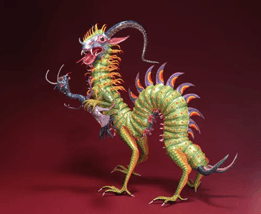
Image 1 - Miguel Linares Mendoza (Mexican, b. 1955) El Gusano (The Worm), 1997 Papier-mâché, paint National Museum of Mexican Art, Chicago – Permanent Collection
A direct descendant of Pedro Linares, the originator of the Alebrije tradition, Miguel Linares Mendoza continues his family’s legacy through fantastical, vividly colored sculptures like El Gusano. Combining animal forms both real and imagined, this creature exemplifies the hybrid nature of Alebrijes—Mexican folk-art figures that reflect personal imagination, cultural identity, and symbolic storytelling.
Created from papier-mâché and adorned with intricate hand-painted details, El Gusano also speaks to the spiritual and dreamlike origins of the tradition. The name “Alebrije” was first coined by Pedro Linares during a fever dream in 1936, and the tradition has since evolved into a celebrated art form practiced across Mexico. While often misrepresented in popular media as part of Día de los Muertos, Alebrijes are rooted in distinct creative and cultural histories—particularly among Indigenous artisans in Oaxaca, where similar forms are carved from copal wood.
This work invites viewers to explore the intersections of myth, memory, and material, and to consider how artistic traditions are preserved and transformed across generations.
Today, Alebrijes are recognized globally as icons of Mexican folk art. Artists continue to craft them using papier-mâché, wood, and other materials, preserving a tradition that fuses imaginative storytelling with cultural identity and pride. These hybrid creatures function not only as vibrant artistic expressions but also as powerful representations of Mexican heritage—particularly in communities that honor the legacy of Pedro Linares and promote the teaching of cultural narratives through visual art.
To extend this exploration of how animals are represented in visual culture, the unit shifts toward a brief historical study of the zoo, where I will show a timeline of zoos and touch on the ideas of how the zoo has evolved to what is now. Just as Alebrijes symbolize imaginative interpretations of the natural world, the concept of the zoo reflects how humans have historically observed, collected, and displayed animals. From ancient menageries to 19th-century zoological gardens, zoos reveal evolving ideas about science, spectacle, and human-animal relationships.
As part of this transition, students will examine the work of two European artists—Jacques-Laurent Agasse and Sir Edwin Henry Landseer—both of whom created detailed animal portraits during the 18th and 19th centuries. Agasse’s zoological studies, including paintings of exotic animals such as zebras, tigers, and hybrid species, were informed by anatomical accuracy and scientific curiosity. Similarly, Landseer’s work often depicted trained or captive animals and reflected Victorian ideals about nature, domestication, and emotional symbolism. Analyzing these artworks provides students with historical context for understanding how animals have been visually documented, idealized, and interpreted—both in scientific and artistic traditions.
This investigation into zoo history and historical animal portraiture will prepare students to contrast realistic animal studies with the imaginative hybrids they will later create in their own Alebrije-inspired works, blending scientific observation with cultural expression.
Comments: